From Factory Floor to Digital Core: America's Manufacturing Reinvention Is Already Underway
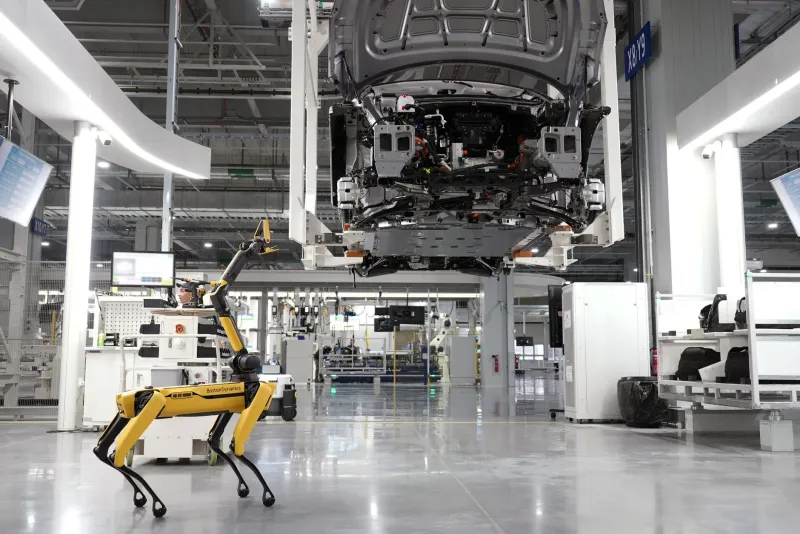
Across the United States, a quiet but profound transformation is rewriting the rules of industrial production. Automation, artificial intelligence, and intelligent supply chain platforms are no longer aspirational concepts—they are operational realities reshaping how American manufacturers compete, scale, and survive. For business leaders willing to act decisively, the window to lead this transition remains open, but it will not stay that way for long.
At TOTOP Group, our mission is straightforward: build tomorrow's industries today. That mandate places us squarely at the center of one of the most consequential industrial shifts in a generation—the digitization of American manufacturing and the supply chains that sustain it.
The Pressure That Sparked the Revolution
The disruptions of the early 2020s exposed a painful truth about American supply chains: decades of cost-optimization had made them efficient under ideal conditions but dangerously brittle under stress. Port congestion, raw material shortages, and labor instability cascaded through industries from automotive to consumer electronics, costing US manufacturers an estimated $1.4 trillion in lost revenue and delayed orders between 2020 and 2022, according to research compiled by Deloitte.
That shock did what years of industry conferences and white papers could not—it forced urgency. Capital that once sat on the sidelines began flowing into supply chain technology at an unprecedented rate. According to McKinsey & Company, global investment in supply chain digitization exceeded $31 billion in 2023 alone, with North American manufacturers claiming the largest share of that deployment.
The question is no longer whether to modernize. It is how fast, and in which sequence.
Automation's Expanding Footprint
Robotics and industrial automation are the most visible dimension of this shift, but the story is more nuanced than headlines suggest. Early automation waves targeted repetitive, high-volume assembly tasks—think automotive welding or consumer goods packaging. Today's systems are far more adaptive.
Flex Ltd., the global manufacturing services company with significant US operations, has deployed collaborative robots—commonly called cobots—alongside human workers in its facilities in Austin, Texas, and Milpitas, California. These systems do not replace workers outright; they handle ergonomically demanding or precision-sensitive tasks while human operators manage quality oversight and exception handling. The result, according to Flex's own reporting, has been a measurable reduction in defect rates and a meaningful improvement in throughput without proportional increases in headcount.
Similarly, Rockwell Automation, headquartered in Milwaukee, Wisconsin, has partnered with mid-market manufacturers across the Midwest to deploy programmable logic controllers and machine vision systems that detect anomalies in real time—catching defects that human inspectors routinely miss during high-speed production runs. The downstream effect is fewer recalls, reduced warranty costs, and stronger customer retention.
AI and the Intelligent Supply Chain
If automation addresses the production floor, artificial intelligence addresses the network surrounding it. Modern supply chains are extraordinarily complex webs of suppliers, logistics partners, customs requirements, and demand signals. Managing that complexity with spreadsheets and quarterly planning cycles is no longer viable.
Companies like o9 Solutions and Blue Yonder have built AI-powered supply chain platforms that ingest data from dozens of sources—weather patterns, commodity futures, port congestion metrics, consumer demand signals—and generate probabilistic forecasts that allow procurement teams to act weeks ahead of disruptions rather than hours after them.
A compelling example is Procter & Gamble, which has integrated machine learning models into its North American demand planning process. By analyzing point-of-sale data from retail partners in near real time, P&G's systems can identify regional demand shifts and trigger replenishment orders before shelves run low. The company has publicly credited this capability with reducing out-of-stock incidents by double-digit percentages across key product categories.
For smaller manufacturers without P&G's resources, cloud-based platforms have democratized access to similar capabilities. Software-as-a-service supply chain tools now allow companies with as few as 50 employees to access demand forecasting, supplier risk scoring, and logistics optimization that would have required an enterprise IT department a decade ago.
The Workforce Transition: Challenge and Opportunity
No honest assessment of this transformation can ignore its workforce implications. The concern that automation displaces workers is legitimate and deserves a measured response rather than dismissal.
The data presents a more textured picture than the headlines suggest. The Manufacturing Institute, an affiliate of the National Association of Manufacturers, projects that the US manufacturing sector will need to fill 3.8 million jobs by 2033—and that nearly half of those positions could go unfilled due to a shortage of workers with the necessary technical skills. The problem, in other words, is not too few jobs. It is a mismatch between the skills workers currently hold and the skills modern manufacturing requires.
Leading manufacturers are addressing this directly. Siemens USA has partnered with community colleges in North Carolina and Georgia to offer apprenticeship programs that combine classroom instruction in programmable logic systems and digital manufacturing with paid on-the-job training. Participants earn industry-recognized credentials while building careers in facilities that are hiring, not contracting.
Toyota's manufacturing campuses in Georgetown, Kentucky, and San Antonio, Texas, have implemented similar upskilling programs, training incumbent workers to operate and maintain the advanced robotics systems being integrated into their assembly lines. The approach preserves institutional knowledge while building the technical capacity that modern production demands.
Legacy Manufacturers at a Crossroads
For established manufacturers that have not yet committed to this transition, the window for comfortable deliberation is narrowing. The competitive dynamics are unforgiving: companies that have already digitized their operations are compressing lead times, reducing unit costs, and improving quality metrics simultaneously. Those advantages compound over time.
Consider the steel industry. Nucor Corporation, one of the largest steel producers in the United States, has invested aggressively in electric arc furnace technology and digital process controls. The result is a cost structure that traditional blast furnace operators struggle to match, even with legacy infrastructure that is nominally depreciated. Nucor's operational approach has become a case study in how incumbents can use technology investment to widen moats rather than simply defend them.
The lesson is transferable across sectors. Whether the industry is plastics fabrication, precision machining, food processing, or industrial textiles, the manufacturers building digital capabilities today are positioning themselves to define competitive standards tomorrow.
What Forward-Looking Organizations Are Doing Now
The manufacturers gaining ground in this environment share several common practices. They are investing in data infrastructure before they invest in automation hardware, recognizing that machines are only as valuable as the quality of the information guiding them. They are partnering with technology vendors who offer integration expertise alongside software licenses. And they are approaching workforce development as a strategic priority rather than a human resources function.
At TOTOP Group, we engage directly with the industries undergoing this transformation—identifying opportunities where operational modernization, strategic capital, and management expertise can accelerate progress. The supply chain revolution is not a future event. It is the present competitive landscape, and the organizations that recognize that reality earliest will be best positioned to lead it.
The factory floor of tomorrow is being built today. The only question worth asking is whether your organization is part of that construction.